How to Choose Your First Fountain Pen for Journaling
A practical beginner's guide to choosing a first fountain pen for journaling — nib sizes, ink flow, grip and weight, and the paper question most buyers forget.
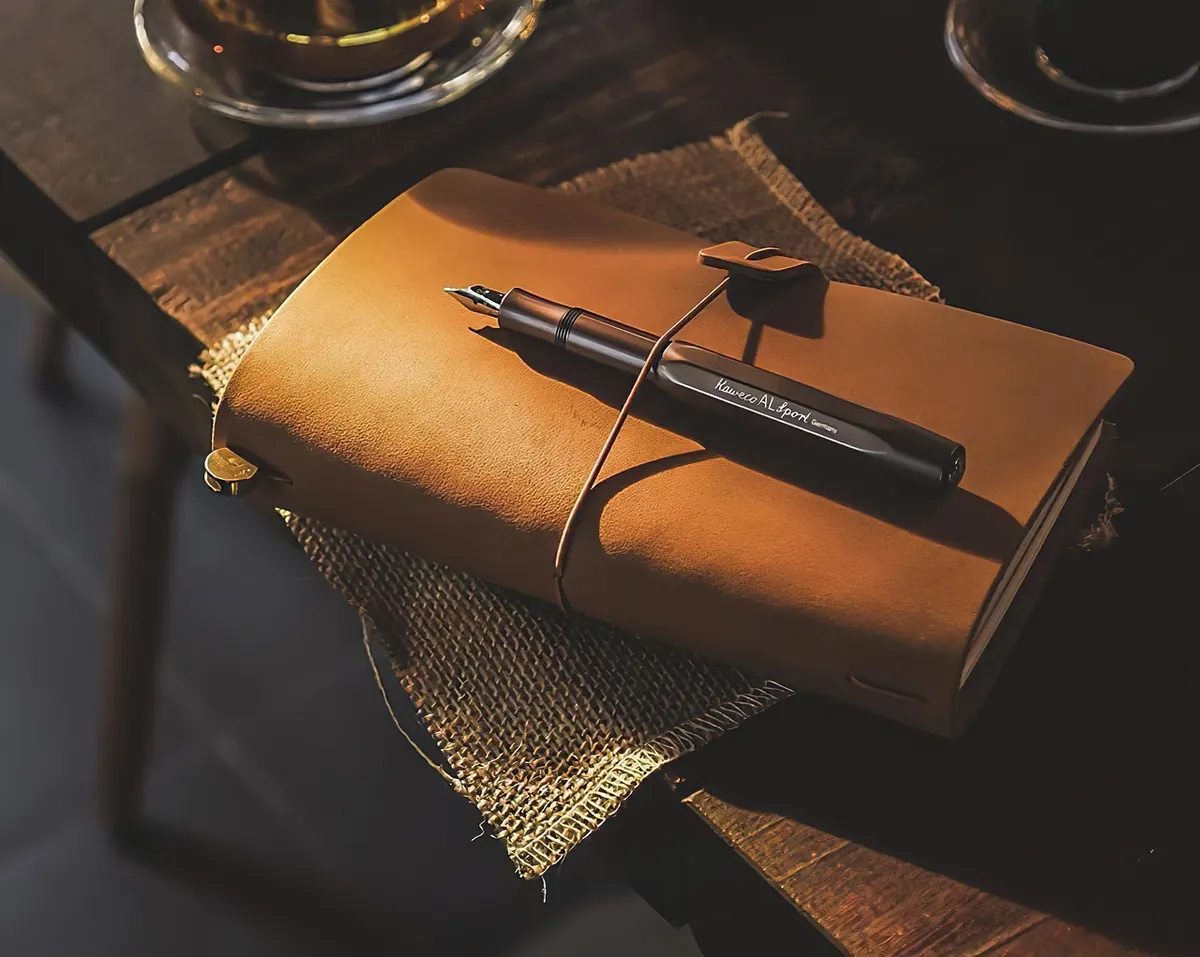
A fountain pen is not a requirement for keeping a journal. A pencil, a gel pen, a cheap ballpoint — all of them will hold a sentence. But there is a reason so many people who write regularly end up with one: ink on paper has a little drag and a little variation, and that small physical feedback makes the page feel less like a screen and more like a place you sat down in. The trouble is that a badly matched first pen does the opposite. It skips, it scratches, it bleeds through the notebook you already love, and you quietly stop using it.
Choosing well is less about brand loyalty than about matching four things to how you actually write: the nib, the ink flow, the way the pen sits in your hand, and the paper you plan to fill. Here is what matters, in the order it will affect you.
Start With the Nib, Not the Pen
The nib decides how wide your line is and how much ink lands on the page, and it is the single biggest factor in whether writing feels good. Beginners usually do best with a fine or medium steel nib. Fine is the safer choice if your handwriting is small, if you write in narrow-ruled notebooks, or if you are using ordinary paper. Medium lays down more ink, which lets the colour of a nice ink show up, and it tends to feel smoother because more lubricant is reaching the page. Broad nibs are lovely for headers and dates, less lovely for three pages of dense reflection.
One thing that confuses first-time buyers: nib sizes are not standardised. A Japanese fine is noticeably finer than a European fine from most manufacturers, so a "fine" from one brand can write like a "medium" from another. Read the size as a relative label within a brand, not as a measurement.
Ignore flex nibs, stub nibs and calligraphy sets for now. A stub makes every letter look like it is trying too hard, and flex rewards a light, controlled touch you have not developed yet. A plain round nib is the right tool for your first year of journaling.
Understand Ink Flow, Because It Changes Everything
Two pens with identical nibs can feel completely different if one writes wet and the other writes dry. A wet pen puts down a generous line — smooth, slightly slower to dry, prone to feathering on poor paper. A dry pen is more economical and better behaved on cheap paper, but push it too far and it feels scratchy and starts skipping on quick strokes.
Most pens arrive reasonably tuned, and you should not go adjusting yours in the first week. Instead, use ink as your tuning knob. Traditional blue, blue-black and black inks from the big European makers tend to run a little drier and behave well on almost anything. Highly saturated boutique inks are often wetter and more dramatic. If your pen feels too wet, try a drier ink before you blame the nib; if it skips, a wetter ink will often fix it.
On filling systems: a cartridge-converter pen is the simplest starting point, and a converter lets you use bottled ink, which is cheaper per millilitre and far more interesting. Waterproof and pigment-based inks are worth knowing about if you want your journal to survive a spilled mug of tea, but they need flushing with water more often — roughly monthly if you write daily.
Grip, Weight and Balance
You will hold this pen for twenty minutes at a time, so the section — the part between nib and barrel where your fingers sit — matters more than the finish. Sections that are too thin, around the width of a cheap ballpoint, force you to pinch and your hand cramps by the second page. Very fat sections are tiring in a different way. Something in the region of ten to twelve millimetres across suits most hands.
Weight is the other half of comfort. Plastic and resin pens in the fifteen to twenty gram range tend to disappear in the hand, which is what you want. Metal pens look serious and often weigh twice as much; some writers love that, but for long entries a heavy pen tires the wrist.
Check the grip shape before you commit. Moulded triangular grips, like the ones on some well-known beginner models, force a correct tripod hold — helpful if you grip too tightly, unbearable if you already hold a pen in your own way. And if you are left-handed, you can use almost any fountain pen; a fine nib with a faster-drying ink will save you a smudged page, and that is the whole adjustment.
Paper Compatibility Is Half the Decision
This is the part beginners underestimate. The same pen can feel silky in one notebook and horrible in another, because paper varies enormously in how it absorbs ink. Three words are worth learning:
- Feathering — ink spreads along the paper fibres and your letters grow fuzzy edges.
- Bleed-through — ink soaks right through and marks the back of the sheet.
- Ghosting — the writing is faintly visible from the reverse side but has not actually bled through. Annoying, but harmless.
Weight in grams per square metre tells you less than you would expect. A coated sheet at eighty grams can handle fountain ink beautifully while a thick, absorbent one drinks it and feathers. The only reliable test is the one you can do yourself: write a line, turn the page, look. If you are buying a pen in person, bring the notebook you actually journal in and ask to dip-test on it. If you are buying online, accept that you may need to pair a wet pen with better paper, or a dry fine pen with the cheap notebook you already have a stack of.
A Practical Buying Checklist
Before you pay, run through these:
- Cartridge-converter filling, so you can start with cartridges and move to bottled ink later.
- A fine or medium steel nib, in the finer direction if your handwriting is small.
- A section that feels comfortable for your fingers, not just attractive on a shelf.
- A cap that seals well — snap or screw both work, but a pen that dries out between sessions will frustrate you.
- A pen you can flush with water in under two minutes, without tools.
- A shop that will let you dip-test, if there is one within reach.
- Enough budget left over for a decent notebook and a bottle of ink. The pen is not the whole purchase.
Give It Two Weeks Before You Judge
New fountain pens feel strange. You will grip too hard, the nib will feel scratchy for the first few pages as it settles into your angle, and your handwriting may look worse before it looks better. Write with it daily for a fortnight before deciding anything. Keep a cheap gel pen nearby for quick notes so you are never forced to use the fountain pen when you are in a hurry.
If it skips or hard-starts, flush it with cool water and a drop of washing-up liquid, dry it, and refill — that solves most problems. If it still drags on a particular notebook, try the pen on different paper before buying a replacement nib; the paper is often the culprit. And if the pen turns out not to suit you, that is useful information, not a failure. You now know something specific about nib width and grip that no review could have told you.
Photo: mylns65hoasphn / Pixabay